Singapore Climate Initiatives: 10 Ways Singapore Is Building a Greener Future
Singapore climate initiatives have become a global example of how a small nation can tackle environmental challenges with practical planning, technology, and long-term commitment. Despite having limited land, no natural resources, and a growing population, Singapore continues to introduce policies and projects that reduce emissions, improve sustainability, and prepare the country for future climate risks.
From greener buildings to cleaner transport and stronger coastal protection, these efforts touch almost every part of daily life. Some are easy to notice, while others work quietly behind the scenes. Together, they show how Singapore is preparing for a more sustainable future.
If you’re curious about what the country is doing—and why it matters—here are ten of the most important Singapore climate initiatives shaping the nation today.
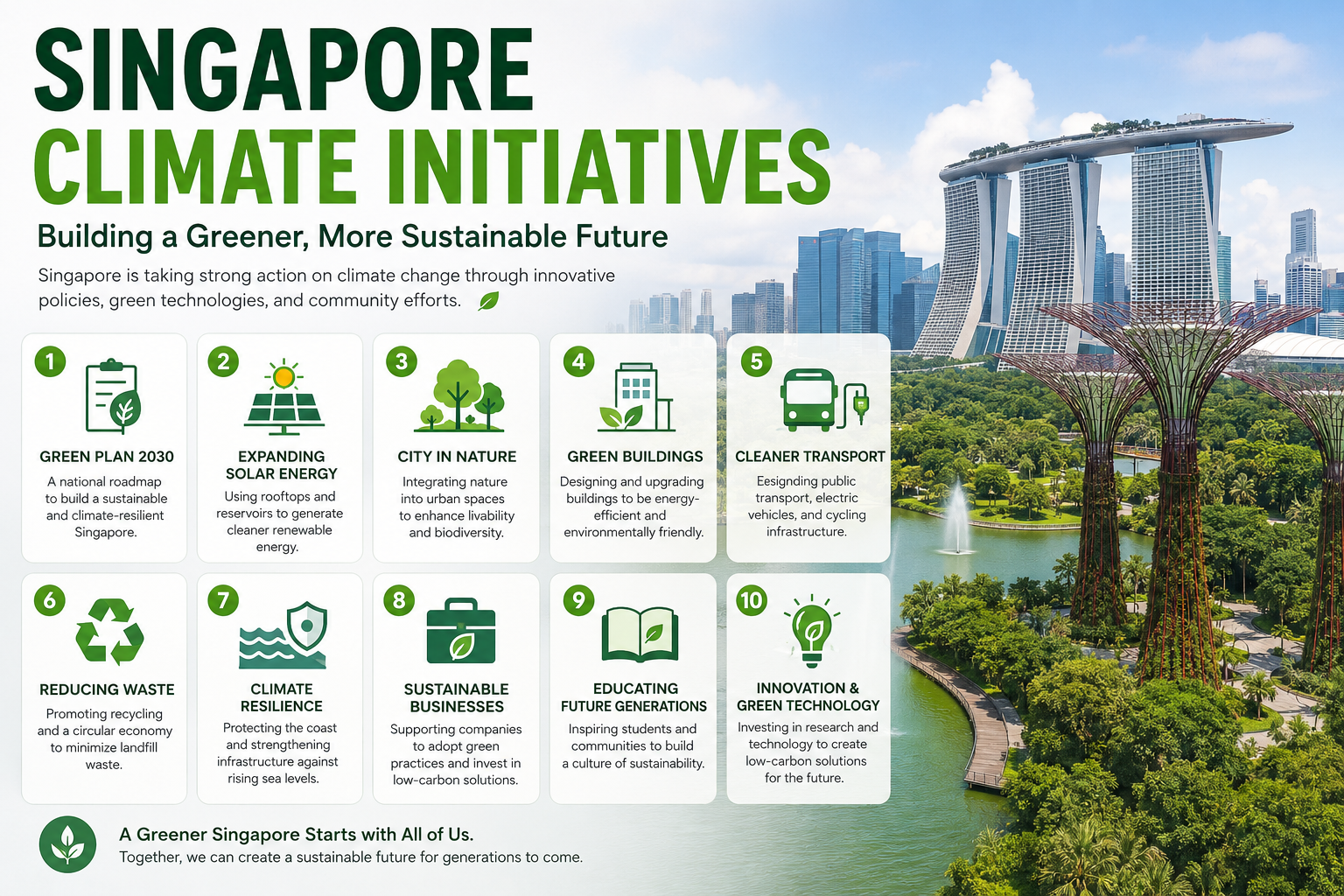
1. Singapore Green Plan 2030
The Singapore Green Plan 2030 sits at the heart of many national sustainability goals. It serves as a roadmap that brings together different government agencies under one shared vision.
The plan focuses on five major areas:
- City in Nature
- Sustainable Living
- Energy Reset
- Green Economy
- Resilient Future
Rather than concentrating on a single issue, the plan encourages action across transport, housing, energy, education, businesses, and public spaces. It also sets measurable targets, allowing progress to be tracked over time.
Many of today’s Singapore climate initiatives are connected directly to this national strategy.
2. Expanding Solar Energy Across the Island
Because Singapore has little space for large solar farms, creative thinking has become essential.
Solar panels now appear on:
- HDB rooftops
- Schools
- Industrial buildings
- Reservoirs
- Government facilities
Floating solar farms have become especially important. They generate renewable electricity without competing for valuable land, making good use of existing water surfaces.
Solar energy still cannot meet every electricity need, but it continues to reduce reliance on fossil fuels while supporting cleaner power generation.
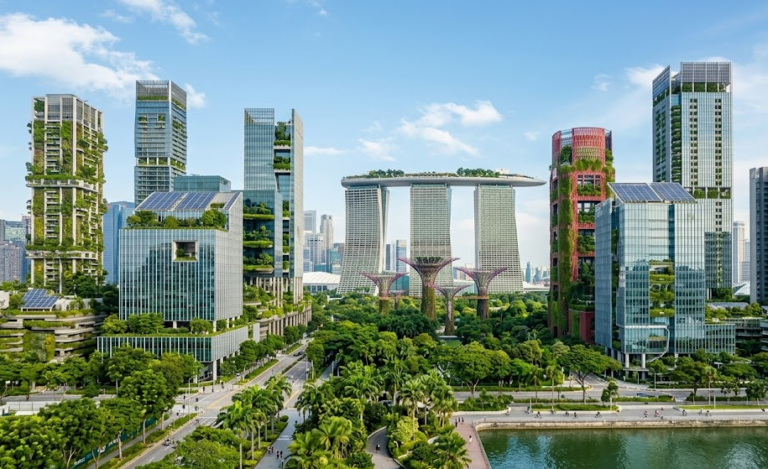
3. Building One of the World’s Greenest Cities
Walk through many parts of Singapore and you’ll notice greenery almost everywhere.
Trees line roads.
Vertical gardens cover buildings.
Parks connect neighborhoods.
Green roofs are becoming increasingly common.
This “City in Nature” approach helps reduce urban heat while improving biodiversity and making communities more pleasant to live in.
Instead of separating development from nature, Singapore aims to combine both. That philosophy has become one of the country’s defining environmental strategies.
4. Encouraging Green Buildings
Buildings account for a significant share of energy consumption.
That’s why one of the leading Singapore Climate Initiatives focuses on improving how buildings are designed, constructed, and operated.
New developments increasingly include:
- Energy-efficient lighting
- Better insulation
- Water-saving systems
- Smart cooling technology
- Sustainable construction materials
Older buildings are also being upgraded through retrofitting programs that improve efficiency without requiring complete redevelopment.
Lower energy use means lower carbon emissions—and reduced operating costs as well.
5. Cleaner Public Transport and Electric Vehicles
Singapore has long invested heavily in public transportation, helping reduce traffic congestion and private car dependence.
RecentSingapore Climate Initiatives efforts build on that foundation by expanding cleaner transport options.
Key developments include:
- More electric buses
- Additional MRT lines
- Larger EV charging networks
- Incentives for electric vehicle adoption
- Improved cycling infrastructure
These improvements encourage residents to choose lower-emission travel options while reducing pollution across the island.
And every year, those changes become easier to notice.
6. Reducing Waste Through Better Recycling
Land is limited in Singapore, making waste management especially important.
The country continues improving recycling systems while encouraging households and businesses to reduce unnecessary waste.
Current priorities include:
- Food waste reduction
- Packaging reduction
- Electronic waste recycling
- Plastic recycling
- Resource recovery
The long-term goal is moving toward a circular economy, where valuable materials remain in use for as long as possible instead of ending up in landfills or incineration plants.
Small improvements across millions of people can make a surprisingly large difference.
7. Protecting Singapore From Rising Sea Levels
Climate change doesn’t only affect temperatures.
Sea-level rise presents one of Singapore’s biggest long-term challenges.
Because much of the country lies close to sea level, significant investment is being directed toward coastal protection.
Projects include:
- Coastal defenses
- Sea walls
- Flood management systems
- Drainage upgrades
- Long-term coastal adaptation planning
These measures are designed to protect homes, businesses, transport networks, and critical infrastructure over the coming decades.
Planning far ahead is a major characteristic of Singapore climate initiatives.
8. Supporting Sustainable Businesses
Singapore Climate Initiatives action isn’t limited to government programs.
Businesses are also being encouraged to reduce emissions and adopt greener practices.
Many companies now focus on:
- Energy efficiency
- Sustainable manufacturing
- Green financing
- Carbon reporting
- Cleaner supply chains
Singapore is also positioning itself as a regional hub for green finance, helping businesses invest in environmentally responsible projects throughout Asia.
This creates both environmental and economic opportunities at the same time.
9. Educating Future Generations
Long-term Singapore Climate Initiatives success depends on people—not just policies.
Schools across Singapore increasingly include environmental education that teaches students about sustainability, conservation, recycling, biodiversity, and responsible resource use.
Community programs also encourage residents to:
- Save electricity
- Reduce food waste
- Recycle correctly
- Use reusable products
- Support local green projects
Changing habits takes time.
But those everyday actions become much more powerful when millions of people participate together.
10. Investing in Innovation and Climate Technology
Technology plays an important role in Singapore’s sustainability strategy.
Researchers, universities, startups, and private companies continue developing solutions that address environmental challenges.
Areas receiving growing attention include:
- Low-carbon energy
- Carbon capture technologies
- Sustainable aviation fuels
- Green hydrogen
- Smart energy systems
- Water innovation
Singapore understands that future Singapore Climate Initiatives solutions will depend on innovation just as much as policy.
That investment helps strengthen the country’s position as a leader in environmental technology across the region.
Why Singapore Climate Initiatives Matter
Singapore contributes only a small percentage of global greenhouse gas emissions.
Still, its actions matter.
The country demonstrates how careful planning, practical policies, and steady investment can produce meaningful environmental progress, even with limited natural resources.
Many cities around the world face similar challenges:
- Dense populations
- Limited land
- Rising temperatures
- Flood risks
- High energy demand
Singapore offers valuable examples that other urban areas can study and adapt.
The journey isn’t finished. Climate change remains a complex global issue.
But each new project moves the country one step closer toward greater resilience and sustainability.
Final Thoughts
Singapore climate initiatives show that environmental progress isn’t achieved through one major project alone. It’s built through hundreds of connected efforts—cleaner transport, greener buildings, renewable energy, stronger coastal protection, better waste management, and community participation.
Some changes happen quickly.
Others take years.
But together they create a more sustainable nation that’s better prepared for future environmental challenges.
As technology advances and climate goals continue to evolve, Singapore will likely remain one of the world’s most closely watched examples of how modern cities can balance economic growth with environmental responsibility.
For residents, businesses, and visitors alike, these Singapore climate initiatives offer a glimpse into what a greener future can look like when long-term planning meets consistent action.